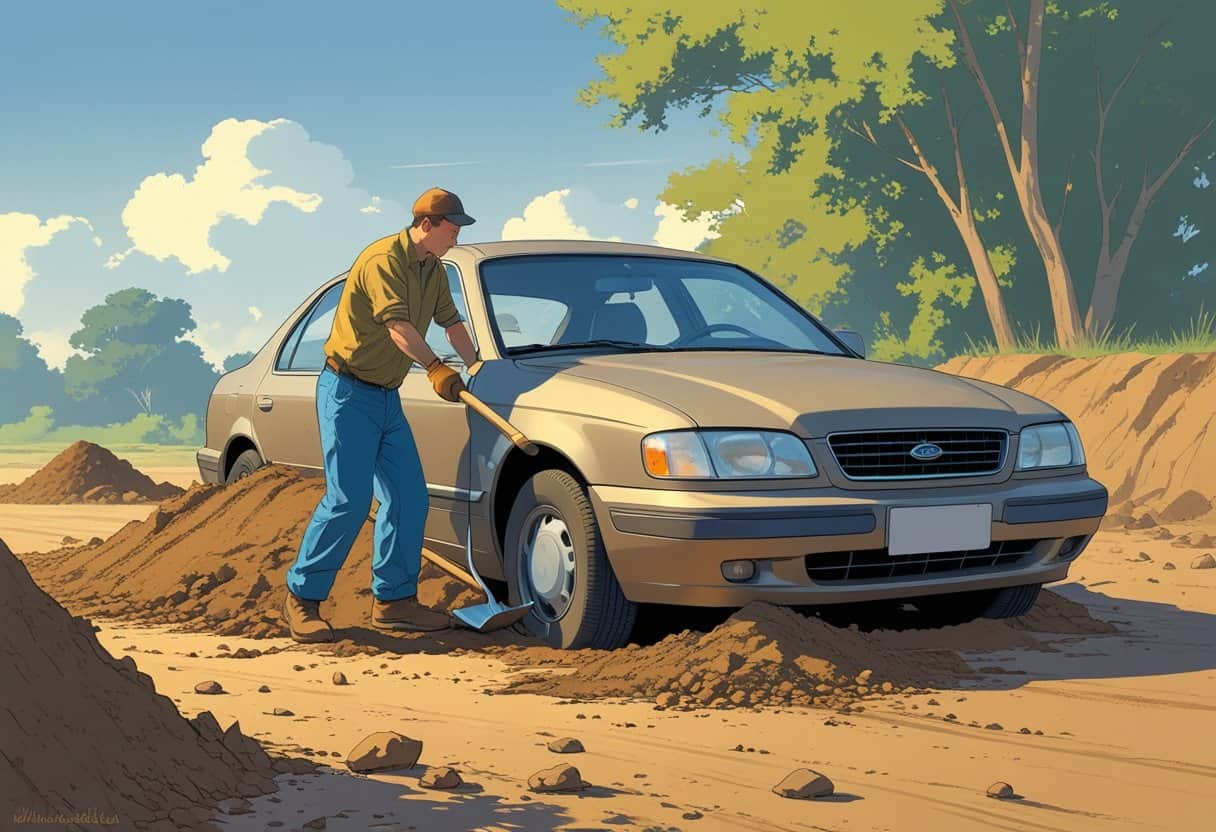
Burying a full-size car with just one shovel sounds impossible, but it raises an interesting question about human effort, physics, and practicality.
We often picture massive machines doing the job, yet the idea of using only a shovel to bury a car challenges how we think about work, time, and efficiency.
In this experiment, we explore what it would actually take to move that much earth by hand.
We’ll look at how soil type, shovel design, and physical limits affect what can be done.
The discussion connects to the famous shovel experiment in scientific management, where researchers studied how to make manual labor more effective.
We also compare this challenge to modern disposal methods, from mechanical excavation to environmentally safe practices.
The Feasibility of Burying a Car with a Single Shovel
Burying a car with one shovel demands significant physical effort, time, and space.
We must consider the soil type, available tools, and environmental rules before attempting such a task.
Even a simple comparison to equipment like a low-quality car smasher highlights why manual burial is rarely practical.
Physical Challenges and Labor Requirements To Bury a Car
A typical car weighs around 3,000 to 4,000 pounds and measures about 15 feet long.
To bury it completely, we would need to dig a pit roughly 20 feet long, 10 feet wide, and 8 feet deep.
That equals about 1,600 cubic feet of soil, or nearly 60 cubic yards.
Removing that much earth with a single shovel would take extreme effort.
Even if one person could move 0.5 cubic yards per hour, the job could require over 100 hours of digging.
Soil type changes the difficulty—clay is dense and heavy, while sand collapses easily.
We would also face safety risks.
Deep pits can cave in, trapping or injuring anyone inside.
Without machinery, stabilizing the walls would be nearly impossible.
The physical strain alone would make this task unrealistic for most people.
Time and Resource Estimates To Bury A Car
Let’s assume we work 8 hours per day with short breaks.
At that rate, one person might finish in about 13 to 15 days, depending on endurance and soil conditions.
Weather delays and fatigue could stretch the project even longer.
We would also need to dispose of the removed soil.
That means finding a place to pile or haul away more than 80,000 pounds of dirt.
Transporting it would require multiple truckloads, fuel, and labor.
Compared to buying a $200-per-year car smasher with a $1 marginal cost per car, as in the Rex Carr example, manual burial costs far more in time and effort.
Even a modest machine would complete the job in minutes instead of weeks.
Environmental and Legal Considerations
If you bury a car it can release oil, coolant, and battery acid into the soil.
These fluids contaminate groundwater and harm plants and wildlife.
Many regions classify this as illegal disposal of hazardous waste.
We would need permits for excavation, waste handling, and land use.
Local regulations often require vehicles to be dismantled or recycled through approved facilities.
Ignoring these rules can result in heavy fines or legal action.
From an environmental perspective, it’s safer to recycle or crush vehicles using licensed equipment.
As shown in the Rex Carr scenario, mechanical methods not only save labor but also prevent contamination and regulatory violations.
Scientific Management and the Shovel Test
Frederick Winslow Taylor studied how workers used tools and time to improve productivity.
His research on shoveling, motion studies, and tool design helped shape modern management practices that focus on efficiency and measurable results.
Frederick Winslow Taylor’s Experiments
We can trace the roots of scientific management to Taylor’s careful experiments at the Bethlehem Steel Company in the late 1800s.
He observed how workers used shovels for materials like coal and ore, noting that each worker used a different tool and moved at a different pace.
Taylor used a stopwatch to measure how long each motion took.
By analyzing these times, he identified unnecessary movements that slowed the job.
His goal was to find “the one best way” to perform each task.
In his well-known Shovel Test, Taylor discovered that the most efficient load for a worker to lift was about 21 pounds.
He then designed shovels sized to hold that amount of material.
According to Time and Motion Studies – Scientific Management Theory, this change increased productivity three to four times and reduced worker fatigue.
Principles of Scientific Management
Taylor summarized his findings in The Principles of Scientific Management (1911), which became a foundation for modern industrial efficiency.
He argued that management should rely on data and observation rather than tradition or guesswork.
We can outline his main principles as follows:
| Principle | Description |
|---|---|
| Science, not rule of thumb | Replace old methods with tested, measured processes. |
| Harmony, not discord | Encourage cooperation between workers and managers. |
| Maximum output | Focus on efficiency and performance, not just effort. |
| Development of each worker | Train workers to perform tasks in the best way. |
As LearningLink’s excerpt on Taylor’s work explains, these ideas aimed to create a system where both labor and management benefited from improved methods.
Tool Standardization and Efficiency
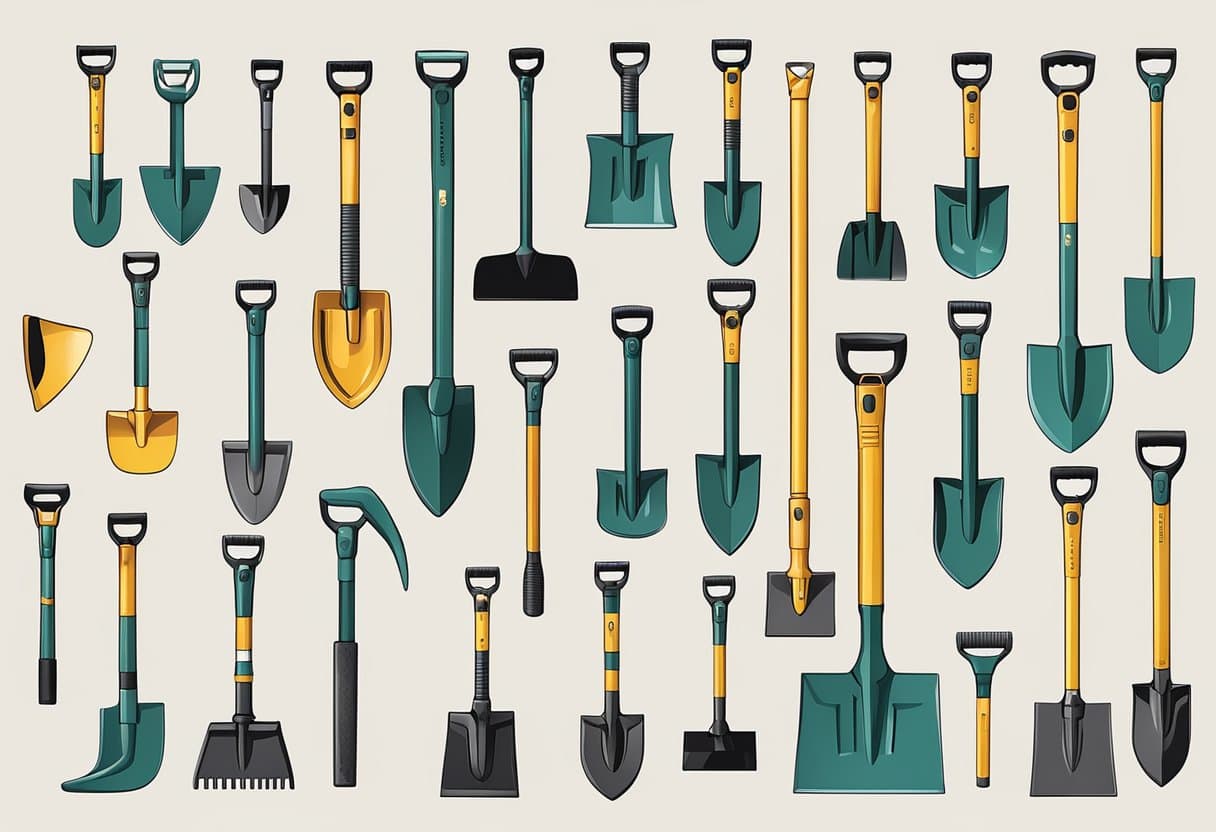
Taylor’s shovel experiments led to the idea of tool standardization, where tools were designed for specific materials and loads.
Before this, workers brought their own shovels, which often were not suited to the task.
By providing properly sized tools, companies reduced wasted effort and improved consistency.
At Bethlehem Steel, for example, workers received different shovels for coal, ore, and ash.
Each design matched the material’s density so that every load stayed near the optimal 21 pounds, as noted by InfinityInternet’s overview of Taylor’s studies.
This approach turned tool design into a science.
It showed how small adjustments—such as shovel size—could lead to measurable gains in productivity and worker satisfaction.
Comparing Car Disposal Methods

Each car disposal method differs in equipment cost, efficiency, and environmental effect.
We can measure them by time, labor, and how well they meet safety and recycling standards.
Manual Shovel Approach
Using a shovel to bury a car demands intense labor and time.
The cost of a basic shovel is low—around $100—but the physical effort is extreme.
Even with help, moving several thousand pounds of metal and soil by hand is slow and unsafe.
Unlike certified recycling, if you bury a car you do not recover materials or meet disposal laws.
In short, the manual method is cheap but inefficient.
Low-Quality Car Smasher
A low-quality car smasher, often a small mechanical crusher, can flatten vehicles but lacks consistent pressure and precision.
These machines may cost a few hundred dollars upfront, but they wear out quickly.
Maintenance costs rise as parts fail under heavy use.
Because of limited crushing power, metal pieces remain uneven, making transport and recycling harder.
The process may still require manual cleanup of fluids and hazardous parts.
Compared with professional systems, this approach saves money short term but reduces metal recovery efficiency.
It also increases the chance of safety issues during operation.
| Factor | Approximate Cost | Efficiency | Safety Level |
|---|---|---|---|
| Manual Shovel | $100 | Very Low | Poor |
| Low-Quality Smasher | $500–$1,000 | Moderate | Fair |
High-Quality Hydraulic Car Smasher
A high-quality hydraulic car smasher offers far greater force and control.
Machines like those used in licensed yards, such as the hydraulic crusher method, cost around $2,000 plus $10 per car processed.
Hydraulic systems compress vehicles evenly, saving space and preparing shells for industrial shredding and recycling.
They meet environmental standards by ensuring fluids are drained before crushing.
These machines handle large volumes safely and quickly.
The hydraulic pressure produces uniform metal blocks ideal for transport and material recovery.
Though expensive at first, they provide reliable performance, lower labor costs, and better compliance with waste regulations.
Cost Analysis and Economic Implications
We compare the financial impact of two disposal methods used by Rex Carr: manual burial using a shovel and mechanical crushing.
Each method carries unique fixed and variable costs that affect total spending, long-term feasibility, and scalability for larger operations.
Marginal Cost per Disposal Method
The marginal cost represents the added expense of burying or crushing one more car.
In Rex Carr’s case, using a shovel costs a small upfront amount but higher labor per car.
The hydraulic crusher, by contrast, has a large fixed cost but lower per-car expense.
| Method | Fixed Cost | Variable Cost per Car | Marginal Cost Trend |
|---|---|---|---|
| Shovel | $100 | $50 | Increases with labor |
| Crusher | $2,000 | $10 | Decreases with volume |
The shovel method becomes less efficient as the number of cars increases because labor time and fatigue raise costs.
The crusher’s efficiency improves with scale since each additional car adds only a small incremental cost.
We can model total cost as:
Total Cost = Fixed Cost + (Variable Cost × Cars Processed).
This simple formula helps us see how marginal cost drives the decision between manual and mechanical methods.
Long-Term Cost Considerations
Long-term costs include maintenance, equipment durability, and opportunity cost.
A shovel wears out faster and requires frequent replacement, while a crusher demands periodic servicing but lasts longer.
We must also consider labor intensity.
Manual burial consumes more time and limits productivity.
Over a year, labor costs can surpass the savings from avoiding machinery.
Environmental and regulatory factors may also influence total cost.
For instance, studies on transportation cost and benefit analysis show that ignoring indirect costs, such as energy use or emissions, can distort the real economic picture.
Applying that logic here, the true expense of each method extends beyond the direct outlay.
Scalability and Practicality
Scalability determines whether a disposal method remains viable as operations expand. The shovel method suits small-scale or short-term use but quickly becomes unsustainable when car volumes rise.
The crusher, though expensive initially, supports higher throughput and consistent performance. It also allows better cost control as the marginal cost per unit decreases with volume.
In large-scale operations, economies of scale favor mechanization. Research on cost-benefit analysis supports this approach, showing that high fixed-cost systems often outperform low-cost manual ones once output passes a certain threshold.
Standards, Safety, and Best Practices
We must follow recognized standards and safety measures when attempting any physical experiment involving soil movement or vehicle handling. Even simple tools like a shovel can pose serious risks if used without planning, proper technique, or compliance with environmental and safety rules.
ISO Guidelines and Compliance
The International Organization for Standardization (ISO) sets global standards that help ensure safe and responsible handling of materials and equipment. Relevant standards include ISO 45001 for occupational health and safety and ISO 14001 for environmental management.
When we move soil or operate machinery, these standards guide how to assess hazards, manage waste, and minimize environmental damage. They also encourage risk assessments before starting any excavation.
| ISO Standard | Focus Area | Application |
|---|---|---|
| ISO 45001 | Worker safety | Prevents injury from manual or mechanical digging |
| ISO 14001 | Environmental impact | Ensures soil and waste are managed responsibly |
Following these frameworks helps us maintain compliance with local laws and avoid unsafe or illegal burial activities.
Safety Risks of Manual and Mechanical Burial
Digging large holes, even with a shovel, poses physical and structural risks. Soil can collapse, especially in wet or unstable ground.
A buried car adds thousands of pounds of pressure, increasing the chance of cave-ins or tool failure. We must wear protective gear such as gloves, boots, and helmets.
If machinery is used, operators should follow manufacturer instructions and maintain safe distances. According to DIY Body Transport by Vehicle: What You Can (and Can’t) Do, even transporting heavy or hazardous materials requires proper documentation and handling, which applies to large-scale burial attempts as well.
Environmental safety also matters. Improper burial can contaminate groundwater or violate zoning laws, as noted in Burial Laws by U.S. State.
Lessons from Real-World Experiments
Real-world attempts to bury vehicles show that manual methods are rarely practical. Excavations often require heavy machinery, soil stabilization, and permits.
In one study discussed in Do You Need Permission to Bury?, even small-scale burials on private land required zoning approval and environmental checks. Experiments that ignored planning often failed due to soil collapse, tool fatigue, or legal restrictions.
Frequently Asked Questions
What is the average time required to dig a human-sized grave by hand?
On average, it takes four to eight hours for one person to dig a grave-sized hole using a standard shovel. The time changes with soil hardness, root density, and moisture levels. Softer or sandy soil allows faster progress, while clay or rocky ground can double the effort required.
What’s the deepest hole that has been dug by hand?
The deepest verified hand-dug hole is the Woodingdean Well in England, reaching about 1,285 feet (392 meters) deep. Workers used basic tools and buckets to remove soil, a process that took several years. This record shows how extreme manual excavation can be under controlled, persistent conditions.
How can you effectively dig your car out of snow without using a shovel?
Use a sturdy board, ice scraper, or even a floor mat to clear snow around tires. Packing sand, salt, or cat litter under the wheels improves traction.